 RSS FEED
Archive for the ‘Managing’ Category
Snow-brain, no pain
February 9th, 2017
 That’s the side of my house after a snowstorm last year. Today we have only about a third of the snow (probably not more than 8 inches today) but it is way too cold and windy for me to want to take pictures. I set out to meet a client at my office after being home all day, encountered slick roads with masses of snow blown across them, and there was a big accident with people in the ditch, tow-trucks, police cars, lots of lights, completely blocking the road out of town. I came home and called the client to cancel.
We’re all disabled, more or less, by the snow. My email yesterday was full of notices of cancelled meetings in anticipation of today’s winter storm. Danny and I both worked from home; college classes were cancelled for Adam. Adam cleared the steps and got a car un-buried and running for me – we’ll have to deal with the rest tomorrow. Snowy days tend to make me feel simultaneously peaceful and antsy – I want to take a nap, I want to run around. I’m just glad I don’t have a migraine.
To add to the litany of injuries and ailments, I managed to herniate a disc in my low back right after Christmas. After several weeks of physical therapy it is feeling much better. I did have a fair amount of pain yesterday and my physical therapist said she thought it was probably the storm coming. I really don’t need another weather-predicting injury. Between my formerly broken elbow, my sensitive head, and my overall nervous system, I already had this human-barometer thing covered. The good news is I have a great excuse not to shovel any snow.
My weather sensitivities used to be mainly around thunderstorms – when a front moved in, I would get a migraine. And often a fibromyalgia flare to go with it. And a sore elbow. The past few summers I’ve been less consistent and weathered any number of thunderstorms without a migraine, but the past few winters I have had migraines triggered by snowstorms rolling in. Those of you who live in snowy climes – you know that peaceful feeling when the snow is falling? I have really missed that, and the snow falling tends to have my head exploding. Not today, I am glad to say. I had a few twinges in the worst of the storm, and when I tried my expedition out my head informed me that it was not keen on the wind that’s blowing out there. But I am counting my blessings. I’m back inside, and warm, and feeling no pain.
Be well, my friends!
– Megan Oltman
Tags: Adam Oltman Porcher, Adam Porcher, fibromyalgia, herniated disc, migraine, weather-related migraine
Posted in Managing, Science | Comments (0)
Did you ever want a whole new head?
January 28th, 2017
If you’re like me, that’s something you’ve asked for many times. My loving son Adam made me another head when he was in 9th grade – at the time when my chronic migraines were at their worst, just before I started working with Dr. William Young at the Jefferson Headache Center. Adam came home one day, and said, “I can’t give you a migraine-free head, but I made a migraine head for you. Maybe all your migraines can go into this head instead of yours.” 
Here it is in all it’s horrifying glory – I think he captured the pain and despair beautifully. 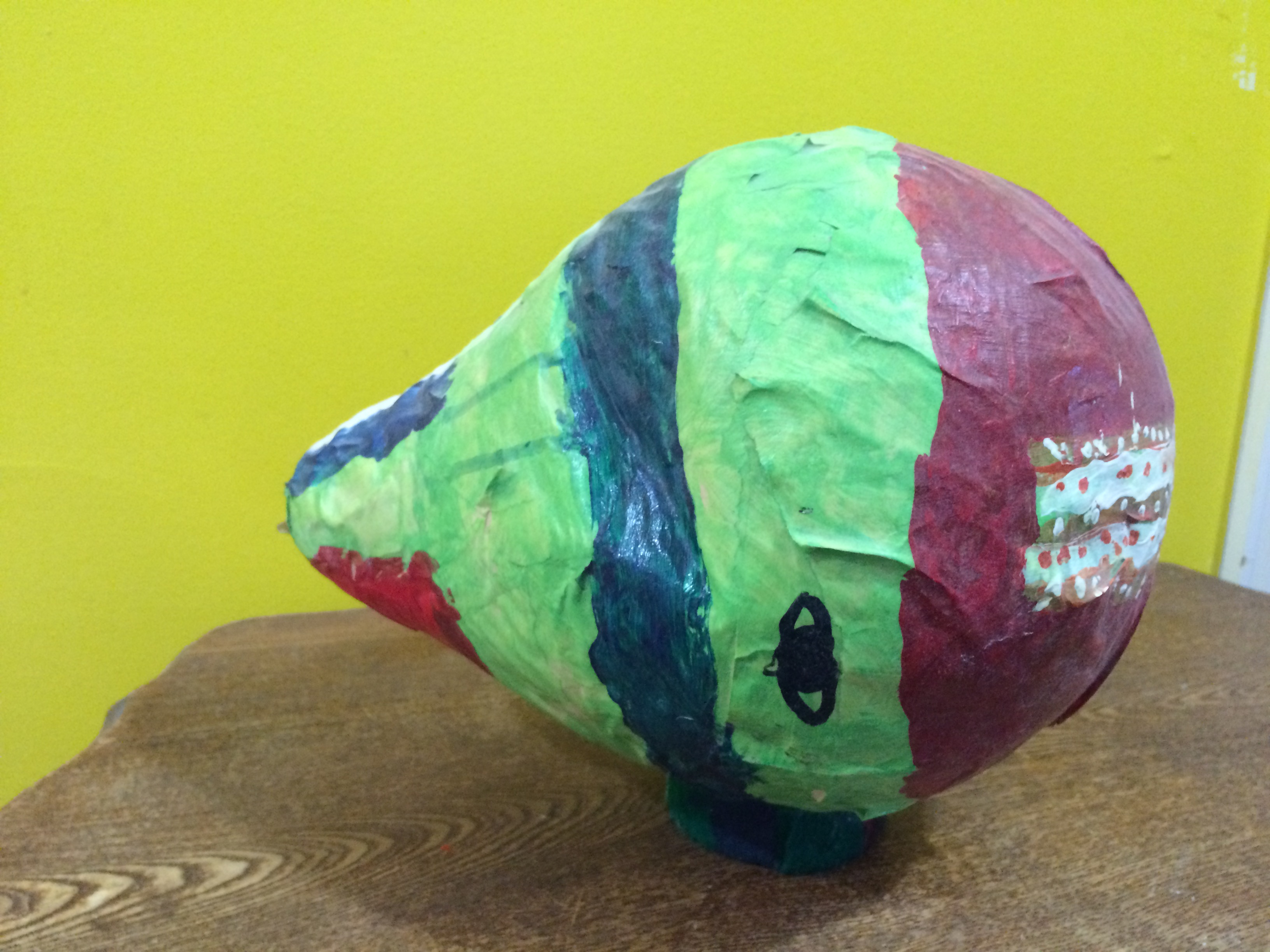
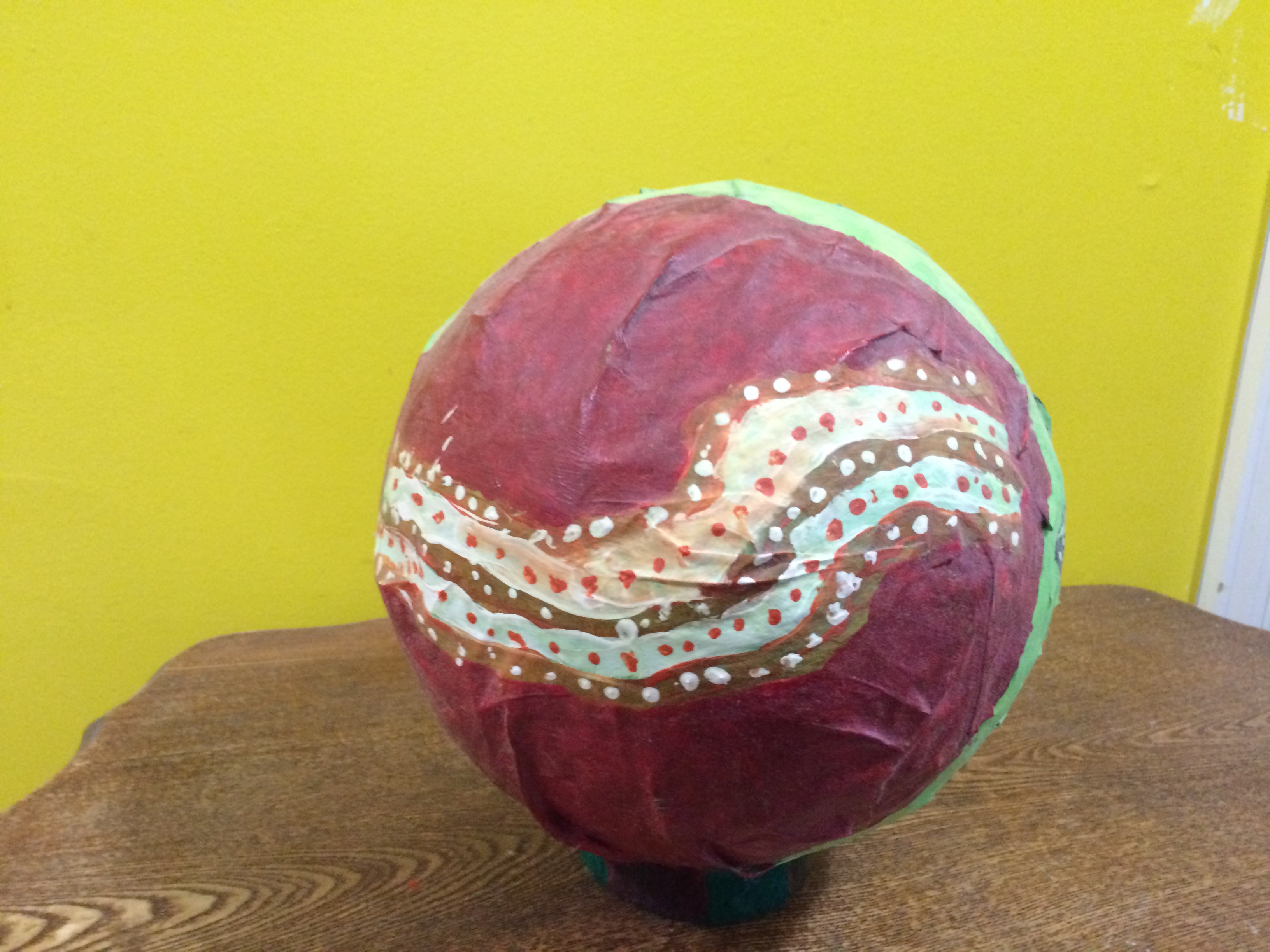
Seven years later, my migraines are no longer chronic. Sure, I had great treatment from one of the best, and learned new techniques to manage my migraines, and menopause came by and blessed me with fewer migraines as well, but maybe the head captured a lot of them on its own. The magic of love. The gift of a truly empathic artist!
Ciao Bene!
– Megan Oltman
Tags: Adam Oltman Porcher, Adam Porcher, Migraine art, Migraine management
Posted in Managing, Musings | Comments (0)
Hitting Myself Upside my Head
April 8th, 2012
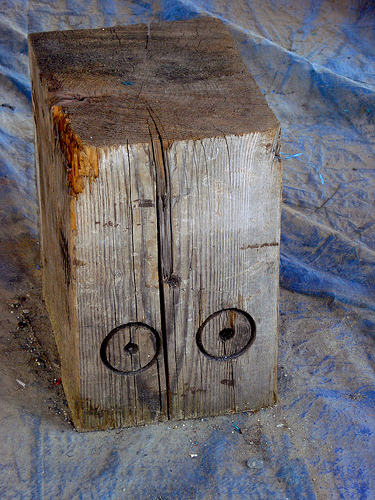 Well, not literally. Not that it would be unheard of in the Migraine world, many of us have banged our heads at times when the beast has settled down upon us. It’s a kind of counter-irritant, I guess. Something, anything, to try to break the repetitive throbbing. Or a distraction, some surface pain to focus on instead of the hideous rending inside the head. I’m really glad I don’t have many Migraines that get that bad any more.
Last Monday I woke up after a rough night, sleepy and with a mild ache on the left side of my forehead. Technically I’m sure it was a Migraine already, but I thought of it, as I often do, as more of a maybe-migraine, a migraine wannabe. My first impulse (so often the right one) was to call in to work, take my sumatriptan and go back to bed. And then the thought entered my mind of the budget for the month, and of the sick leave hours I try to budget too, and how since my Migraines have become less frequent I sometimes have a little headache that doesn’t turn into a full-blown Migraine. So my little headache and I went off to work, and chose to focus on the less mentally taxing of the tasks on my desk, and did most of my thinking out loud to help me focus, and took a walk at lunch, and did all I could to keep the beast at bay.
But I was talking about head-banging. Which I wanted to do before the night was out. I got home and tried to focus on all the stuff I try to focus on after work, like visiting my on-line world, Migraine related and otherwise, and helping Adam manage his homework, and imposing some kind of order on the chaos that is my home, and trying to build up and work on some of my free-lance work, and I found all I could do was go take a sumatriptan and lie down.
I set the alarm for about an hour and a half, rolled a pillow under my aching neck and dosed off, hoping the pill would do its job. And woke up groggy when the alarm went off, groggy and in pain. Groggy and nauseous and hungry and in pain. It was not yet two hours from the time I took the triptan, so I couldn’t do another dose, and the pill had had no noticeable effect. So I had to wait 15 minutes or so, and I needed to eat something for my blood sugar which was dropping (contributing to the Migraine). The head had started throbbing, one of those times when I imagined I could specifically feel each dilated vein around my brain pulsing and stretching and shoving against my skull.
So did I hit myself upside the head? In a sense. I didn’t actually feel like head-banging this time, though it was the worst Migraine I’ve had for a few months. Probably about an 8 out of 10 this time, the kind that makes me cry. I knew I had to bring out the big guns this time. I had to give myself a sumatriptan injection. A highly effective way to abort the Migraine, but which I put off and avoid as long as I possibly can. Why on earth would that be, you ask? If you have to ask you have never had one of these injections, or you are lucky enough not to experience them the way I do. First of all the injection itself hurts. It’s a spring-loaded injector; you shove it hard against your arm and hold it there, pressing until it injects. It’s not a jab, it’s a SLAM-STAB, and you have to keep pushing that thing in for 30 seconds to make sure all the medicine goes in, I do it while breathing hard through my gritted teeth.
Then you need to take your sore and aching arm and get yourself prone as quickly and smoothly as you can, so you can be lying down as st ill as can be when the real head slam comes. For me, and I understand for many others, the injection causes a “surge” of increased head pain before it begins to work. So the only thing, sometimes, that will make the pain go away, is a short-term, extreme increase in the pain. When I say short-term, it’s not an agonizing 30 seconds like the injection torture. It’s a good five to ten minutes of the front of my head feeling like it’s being hit with a tire iron, from the inside.
The only thing that gets me through to the other side is lying on my back as still as I can, doing my relaxation breathing. I have to go into the pain, be with the pain, and visualize my breath carrying the pain away, out with each exhale. And eventually I fall asleep, and usually in that sleep the pain goes away.
This time it took a long time, almost until morning, before the pain lifted. If I’d followed my original impulse and taken a pill in the morning before the pain was much of anything, I probably wouldn’t have needed the injection. If I’d taken the injection right away when I got home I probably would have been pain free in two hours. But I couldn’t bring myself to hit myself upside the head. Until there was no alternative. If you’ve been there, you know what I mean.
– Megan Oltman
Tags: Adam Oltman Porcher, Adam Porcher, Migraine pain, pain management, sumatriptan, triptans
Posted in Communicating, Managing | Comments (2)
Life and Migraines go on…
June 7th, 2011
It’s ten o’clock on a Tuesday night and I have a little bit of a Migraine – one of those left-over ones.  Left-over Migraine is not a clinical diagnosis, mind you. Just the way I describe it – had a nasty one Saturday and all day Sunday and then a bit of a sore-headed post-drome yesterday, which morphed back into a full-blown head-banger by bedtime. And here we are the next day still sore.
A few years ago this was par for the course, and I would have strings of days like this most weeks. Now I am very happy to say that most Migraines I get are mild and abort easily and resolve completely inside of a 24 hour period. Of course whenever there’s an exception, like this week, I get afraid that this will be the new normal – that my chronic days will return. That’s one of those moments when I have to thank my fears for sharing and move on. Get grateful, recognize how far I’ve come, and let go.
So the good news – it doesn’t happen to me often these days. The bad news – I have a harder time taking it seriously and really stopping the action and taking care of myself than I did when it happened more often. Of course, other things have changed, too. Instead of being not very gainfully self-employed I now have a 3/4 time job and work on building a private mediation practice in the other theoretical 1/4 of my time. (It’s theoretical because… with fibromyalgia, episodic Migraines, extremely strained finances, a job-seeking husband and a teenager with ADHD, a dirty house to try to keep somewhat on top of… I ain’t got much time!)
 I’m still not all that gainfully employed, but I’m glad to have a job. I went in a pretty short time span from being semi-disabled to being almost the sole support of my family. Times are tough. I can relate to the many Migraine sufferers I have interacted with through the years who say “I don’t have time to be sick.” I can dig it. I’m there. I can only work as much as I do because I have gone from chronic Migraine back to episodic Migraine, but I do worry that the level of stress in my life is such that I could get kicked over into chronicity again. (I don’t care if that’s not a word – I like it anyway.) So… I meditate. I take walks. I pray. I put everything aside and just relax. I practice my affirmations. I get up in the morning and get on my happy face and face another day. Keep putting one foot in front of another and doing the next right thing.
I actually came on here tonight just to say, I wish I had more time to blog. To read and comment on all my beloved chronic pals blogs, and post on My Migraine Connection, share on line, and all that. I had over 200 comments waiting for me here, over 180 of them spam. I haven’t found the time to install the stronger spam filter that the fabulous Diana Lee recommended to me. I haven’t found time to reply to the many people who went on the contact page and asked me if I’d like to do a link exchange (yes, yes, no, yes, maybe, let’s talk…), or asked me if I want to hire them to do SEO for me (no, no, no, leave me alone, don’t you think I have my own people to work on that?), or asked me for advice (oy vey).
The good news is life does go on. I am so glad to be down to an average of 2 – 3 Migraines per month. This is huge. There’s a whole lot of living that can fit around 2 – 3 Migraines a month. I wish that living didn’t happen in the midst of a whole lot of economic hardship, but how much worse it would be to be sick like I used to be and going through this. So I guess I can put up with a left-over Migraine, for now.
Hang in, maties, it gets better. That’s what I’ve gotta keep on believing, anyway.
Love,
Tags: chronic migraine, episodic migraine, fibromyalgia, migraine
Posted in Communicating, Managing | Comments (3)
Walking with Fibromyalgia
October 20th, 2010
I am counting on some of you old hands at living with fibro to chime in on this one, okay? I believe I have  had fibromyalgia for at least 15 years, and maybe for 35 years. I’ve only been diagnosed for a little over a year, though. My fibro seems to have grown a lot worse in that year as well. What I can’t tell is whether the fibro just seems worse because my Migraine disease has gotten so much better that I can actually notice the fibro now.
I think it is worse, though. Certainly the fatigue is nothing new, that’s a fifteen year old problem, which I thought was ME/CFS. It was raising the question of dealing with Chronic Fatigue Syndrome (CFS) with my headache specialist last year which led him to press my fibromyalgia tender points, and led us both to realize that it was fibro that was the issue. since then things I’ve been experiencing for a while have “clicked,” like how a slap on the shoulder or the teasing pokes my son gives me can really hurt, for a long time. Things that used to be just mildly uncomfortable or unpleasant cause actual pain now. What is new is the feeling that my aching arms weigh a ton and are likely to fall off. This is after a day of sitting up at a desk typing.
I’m finding this disease a hard one to learn to manage. I try to keep my activity level fairly steady from day to day, but if I do get a flare I need to rest for it to go away. Then I’m back to a very inactive state and have to slowly build up all over again. I always want to do many things when I do have the energy for them, but I can cross the line to overdoing so easily.
Saturday, for example. A couple of our dearest friends were in NJ/NY for the weekend – in from Minnesota. It gave us the impetus to do a deep cleaning of the downstairs – one it had needed for a long time. But the day s tarted at 6:30, because Adam took the PSAT today, and then we cleaned for several hours until they arrived. We had lunch and lots of talk, a too short wonderful visit of a few hours. I did take a nap after they left, but as the sun was starting to go down I was seized with the desire to be outdoors in the bright chilly Autumn day, and walk in the park. (What’s the good of living in the best spot in our little town if I don’t get out and enjoy it?) So I took a good 20 minute walk through the paths in the fields. Then I sat on the bed, propped up on pillows, blogging. There was still laundry to be done but I had expended about as much muscular effort as I should for one day (if not more). I ached a bit, but who knows how much more would have set up a flare? It’s very challenging.
Tags: Adam Oltman Porcher, Adam Porcher, exercise, fibromyalgia, fibromyalgia tender points, ME/CFS, Migraine disease
Posted in Managing, Musings | Comments (0)
Becoming Trigger-Resistant
October 18th, 2010
 I am very fortunate to have my Migraine days down to 3-5 a month now, and most of the Migraines are relatively mild and abort quickly. One thing I notice is that individual Migraine triggers are not so much of an issue, but a whole stack of them will still prompt a Migraine. For instance I can get by for a couple of days with not quite enough sleep, smell some perfume (or more often the bane of my existence, the heavy sweet Axe many of my son’s friends like to wear – Uggh!), be around some smoke, be in a crowded room, and I may get some little twinges that tell me to back down and do some breathing exercises, but they don’t develop into a Migraine. Then say all those things are present and a meal is delayed and my blood sugar gets low, and whammo!
I’m up to 30 hours a week of work at the law firm now, so there’s less flexibility for missing time. My boss is very understanding and lets me build my schedule the way I want, as long as it doesn’t interfere with the flow of work. But if I miss a day or half a day because of a Migraine, I can only make up the time by working longer hours another day, and a day longer than 7 hours (6 working and 1 for lunch) takes a lot out of me. Not that a long day will necessarily trigger a Migraine, but sometimes it does if it’s a rushed or stressful one. Usually the effects are less direct – a long day sitting up at my desk typing will trigger a fibromyalgia flare, and if I don’t manage some rest time to help the flare pass, it’s common to get a Migraine on the tail of the fibro flare.
I know I’ve been talking to you all for quite a while about relaxation exercises and breathing, and I use them nearly every day. They have certainly helped my transition back to near-full-time work. As valuable as they are though, I wouldn’t be where I am now without a good combination of Migraine preventives. Nortriptyline not only reduced my Migraines it greatly reduced my anxiety level and helped me sleep like a log most nights. Then lisinopril lowered my blood pressure and continued the job of reducing the Migraines.
I feel like I’m coming back to life! We have been out socializing nearly every weekend, and I’ve been getting walks in nearly every day again. Right now fibro is more of a problem than the Migraines. I’m finding it tricky to learn how to manage.
– Megan Oltman
Tags: fibromyalgia, migraine, Migraine preventives, Migraine triggers, relaxation techniques
Posted in Communicating, Managing, Musings | Comments (1)
The Language of Pain – a review
August 29th, 2010
 I recently finished The Language of Pain, by David Biro, M.D. A practicing physician in Brooklyn, NY, Dr. Biro also has a PhD in literature. This interesting combination of educational disciplines, together with Dr. Biro’s own experience as a patient with a blood disorder, leads to his thoughtful and philosophical writing on the isolating experience of pain. I presume that his earlier book, One Hundred Days: My Unexpected Journey from Doctor to Patient must focus more specifically on his personal (and unexpected) experience in bridging those worlds. The Language of Pain is a more general and outer-focused book, discussing how profoundly isolating the experience of being in pain is (be it physical or emotional pain) and how important it is to find means of expressing the experience.
The Language of Pain is an interesting read, pointing out that an understandable expression of the pain one experiences is necessary both to get proper treatment for the pain (or the underlying condition that causes the pain), and to keep people in pain from being isolated from their families, friends and community. Drawing on many examples from art and literature, Dr. Biro explores how metaphor enables us to take the diffuse experience of pain and put it in terms that others can understand. The book is illustrated with some of Frida Kahlo’s gripping paintings, as well as patient-generated works of art gathered by Deborah Padfield in a pain clinic in the UK, and other art. We read many passages from literature describing pain, disease, and bodily peril, from works by Tolstoy, London, Crane and Joyce, among others.
This is not a long book, but it took me a long time to finish. I found that some of the descriptions of pain were, well, painful for me to read. It may be that for one living with chronic pain, this book hits too close to home. Nor is it an easy read. His points are excellent, but perhaps Dr. Biro couId have expressed them in a more accessible manner. This may sound funny coming from me; an inveterate user of big words. I could have used less literary and philosophical analysis and more practical examples of how finding language for their pain has helped pain patients.
The book is subtitled “Finding words, compassion and relief.” Without doubt the writing is compassionate, and ignites the reader’s compassion. There was inspiration for me personally in the examples of words used to express pain; certainly I remembered them in my own moments of pain, and tried to be more conscious of expressing myself. It is the “relief” that I would like to have heard more of in the book. Maybe because relief from pain is something I long for in my own life, and for other sufferers. It wouldn’t be fair for me to fault Dr. Biro for not providing a magic wand! He pulls it all together very well in his postscript, stating:
More than just communicating one person’s experience, the metaphors of great writers contribute to our collective experience of pain. They add to our ever-growing repository of language, and to our ever-growing understanding of what it means to be human. Indeed, we should think of our great artists no differently than our great scientists. Both have profoundly practical goals; each works to help us understand and talk about what is not fully understood or communicable. But where the scientist shines his searchlight on the objective world, the artist strives to illuminate the subjective one.
One of the things that fascinates me most is the meeting and communication of our left and right brains, our analytical and intuitive sides, the scientist and artist in each of us. I love thinking about what having both an MD and a PhD in literature would bring to a person’s thinking and understanding of the world. Dr. Biro thank you, you have done an elegant job of sharing your thinking with us. I’ll expose my own prejudices as a coach when I ask, next book, would you give us a little more of how to use those two sides of the brain for relief in our own lives?
– Megan Oltman
To keep the FTC happy I will disclose that the publisher asked me if I might like to review the book in my blog, and sent me a free copy so that I might do so. They did not pay me to puff the book, and I won’t receive anything else from doing this review unless some of you decide to link in to Amazon and buy it there, which would net me a few pennies per book. The publisher has no doubt given up on me, as they sent me the book before it’s publication in January of this year.
Tags: chronic pain, David Biro MD, Deborah Padfield, Frida Kahlo, Jack London, James Joyce, Leo Tolstoy, living with pain, pain, Stephen Crane, The Language of Pain
Posted in Books, Communicating, Managing, Medicine | Comments (0)
A Certain Level of Brain Freedom
August 22nd, 2010
I am enjoying a long stretch of freedom from pain in the brain. Hooray! I have had only six Migraines since late June. Less than one a week! A better rate than I’ve achieved in the past three years, at least. I began taking the blood pressure medication Lisinopril in late June, and this seems like a winning combination for me. My current regimen includes:
- Nortriptyline 50 mg at bedtime (a tri-cyclic antidepressant, taken at a very low dose for Migraine prevention, it has also helped my sleep and lowered my anxiety level);

- Lisinopril 20 mg (10 at bedtime and 10 at breakfast);
- High potency multi-vitamin;
- Magnesium 400 mg;
- B-Complex 100 mg;
- B-2 300 mg;
- CoQ10 300 mg;
- Armour Thyroid 60 mg;
- Iodoral iodine supplement;
- DHEA 10 mg at bedtime;
- Melatonin 3 mg at bedtime;
- Omega-3 fish oil supplement;
- Pro-greens pro-biotic supplement;
- At least 84 ounces of water per day;
- daily walks;
- daily relaxation practice.

That’s about 15 pills in the morning and 6 at bedtime. If that’s the price of freedom, I can live with it. As always, an unintentional experiment proved how well this regimen is working for me. A few weeks ago I had a Migraine on a Thursday evening and, as I sometimes do, forgot to take my bedtime pills as I was treating the Migraine and everything else went out of my head. The next day we were leaving just after work for our cousins’ beach house and I got up early in foggy post-drome and packed for the weekend before work. I forgot to pack my pills! So just as Danny was leaving the house to come meet me at my office, I called him and asked him to pack them for me. He did that, but when we met up and transferred the bags from the car he was driving to the other, the bag of pills got left behind. We discovered this at about 10 pm at the beach house. So I went without pills for a second night in a row, and missed my morning doses Saturday morning. Danny was a hero and drove over 6 hours round-trip to go get my pills so I could stay through Monday. Two nights and a morning without had a cumulative effect, though, and I had a pretty severe Migraine Sunday night. It is now two weeks later, took my pills every day and no Migraines in that two weeks!
My Migraine specialist, Dr. Bill Young of Jefferson Headache Center, had said to me , “Six to seven Migraines a month isn’t good enough. We can do better!” (Love this guy! Compare with the last guy who thought I should be satisfied with reducing from 10 a month to 7.) So when I went to my last appointment in late June with the news that my blood pressure had been running high, for the first time in my life, he was excited! I had to tease him about that, how many physicians would say, “Oh good!” on learning that their patient had developed high blood pressure! But he explained that anti-hypertensives can be excellent Migraine preventives, but can’t be prescribed if the patient’s blood pressure is too low. He was confident that the two medications together, along with all my other supplements, would produce better Migraine prevention results for me. And so far, so good! I try not to really measure a trend until it’s been going on for several months, but early results look promising. I am loving the extra time and energy I have for hanging out with family and friends, and getting some chores and projects done around the house. Now if I could just manage the fibromyalgia…
For any of you who see doctors who only know a limited number of Migraine preventive options, or who aren’t comfortable with combining several medications, or who aren’t knowledgeable about supplements, find another doctor! If you aren’t doing daily relaxation, meditation, yoga or another practice to calm your nervous system, get on it! It can take time, but most of us achieve a significant level of brain freedom.
Hope you’re doing well. Leave me comment and let me know how you’re getting on, okay?
Smoo cave waterfall photo courtesy of Subflux.
Tags: fibromyalgia, Jefferson Headache Center, managing life with migraine, migraine, Migraine preventive medication, William Young M.D.
Posted in Managing, Medicine, Uncategorized | Comments (0)
Who You Calling Disabled?
June 5th, 2010
I hesitate to call myself disabled. I work 25 hours+ a week at a demanding job, I do get out and see people,  sometimes, and I’m down to only 3 or 4 days a month in bed. Most days I can wash the dishes and straighten up a bit, more than half my days I get some exercise, many days I can manage the laundry. I’m down to 5 to 7 Migraine days a month, from 12 to 20 a few years ago. Although I have some fibromyalgia pain many days, days like today when I feel wrung out and ache from head to toe don’t come more than 2 or 3 times a month. So who’s calling me disabled?
I push forward through my life with a great deal of determination and most of the time I confidently expect  to get better and better. I have learned so much about how to take care of myself, how to manage my various conditions, and I’ve really improved so much. Days like today, where all I can manage is some reading, some hanging out on line, some tv, when I travel from the bed to the armchair to the bathroom to the kitchen, and that’s a major undertaking, days like today can fill me with despair. I may never get any better than this. I have to accept that possibility – not that I won’t keep on getting up and being positive (mostly) and working striving and pushing (and breaking down when I push too far). But maybe this is as good as it gets.
I am researching Migraines and Social Security Disability for an article I’m planning to write. I encountered the blog of a disability law firm who have helped a number of Migraineurs to get their disability recognized, and compensated. Here’s what struck me. In writing up a Migraine Disability case study, Lawyer Jonathan Ginsberg recounted that the vocational witness called in his client’s case testified that although she felt the claimant could do light duty, low stress work, that no jobs existed that would allow her to be absent 4 to 7 days a month. It’s hard to do this kind of research and really stay detached, and reading that I thought, wow, I could easily need to be absent 4 days a month! The fact that I work less than full time, and for a flexible and understanding boss, makes it possible for me to switch hours around and avoid some of those sick days. But I would be disabled under the same criteria that got the woman in that case granted disability benefits!
Then there’s the MIDAS scale. MIDAS is the American Headache Society’s Migraine Disability Assessment Test. A year ago my MIDAS score was 57 – Which is “Grade IV Severe Disability.” I have been retaking the assessment every few months, and I am down to a 30. Great progress! Guess what a 30 is? “Grade IV Severe Disability.”
I am not knocking my progress, really I’m not. I recently had a reader write in and ask me how to take back her life from Migraine. That’s certainly a phrase I’ve used a lot. Having 5 to 7 Migraine days a month is incredibly much better than having 12 to 20. Being proactive, recognizing our sensitive nervous systems and caring for them, looking at the areas we can impact and working on them, all of these things do make a difference. I am doing better all the time, building up my stamina (though slowly), and managing these days to earn somewhat of a living, which is nothing to sneeze at. But I felt I needed to tell this woman, you can take your life back in the sense of being in charge of your life, but that doesn’t mean you can make the disease go away.
There come those days, like today, when I slam into the brick wall of my own limitations. I worked a long, hard, stressful week this week and today I woke up feeling like I had been pushed through a strainer. Do any of you recognize that one? I’ve felt it on and off for many years, at least ten, and now I recognize it as a sign of a fibromyalgia flare. I feel strained, like my nerves and muscle fibers have been stretched, shoved, pushed, shredded, sieved, including the nerves in my temples that start the Migraines. Days like today feel blank, wasted, and I cried this morning at the prospect of a life ahead filled with days like this.
My disability is invisible, at times even to me, but it’s there. I will keep on striving. And I also need to be with what’s so, that this is who I am. I am this person with a hyper-sensitive nervous system, I do need days of recovery from just the normal everyday days of life.
I know I’m incorrigible, but I have high hopes for tomorrow.
– Megan
Tags: disability, fibromyalgia, MIDAS, Migraine disease, Social Security disability
Posted in Managing, Musings, Uncategorized | Comments (0)
Surviving the Perfect Storm
May 15th, 2010
 My Migraine triggers generally include: lack of sleep; sleep at irregular hours; missing meals or going too long without eating (low blood sugar); working hard when tired (over-exertion, let-down after stress); hormonal fluctuations; electrical storms and barometric pressure changes; loud noises; crowds; smoke; crying; change of altitude. Last night I sat through a perfect storm of triggers without actually getting a Migraine. Every trigger but the last three were present.
It went like this: I went to my Friday morning BNI meeting, which involves getting up at 6. That wouldn’t be too bad if I managed to get to sleep by 10 or so, but I never do. I go to sleep between 11 and 11:30 most nights and I have a very hard time cutting my evening shorter. Ideally I would go to bed and get up at the same time every day; it would be best for Migraine prevention and make those Fridays easy to bear. But I live in a household of night-owls and I’ve never been able to reconcile myself to having a completely different schedule from the rest of my family. Besides, most of my favorite tv shows are on from 10 – 11! So I got up and got going on less than 7 hours of sleep.
I worked hard all day, working with an intensive focus towards a deadline. It was a warm muggy day with thunderstorms in the forecast, and the building storm was palpable in the air. Then at the end of the working day I attended a charitable event that I was invited to by a friend. It was really a lovely event, a tour of a designer show-house and a dinner in a tent in the back with a couple of presentations, then arias by a couple of opera singers, and finally they held an auction.
I didn’t make it that long though. The thunderstorms broke while we were touring the house, and it was still raining when we went out to the tent. One of the sponsors of the event was a local appliance store, and one of the presentations was on outdoor kitchens. So they got a great local chef to cook a meal (for at least 100 people) on a huge outdoor grill that was being auctioned off. All a very nice concept, but apparently no one had really thought through how long it would take to grill several courses for 100 or more people. They began serving wine before the presentations started; an hour or more later they passed around some little cubes of grilled bread. The next course, grilled vegetables, came out more than half an hour later. then some grilled seafood at least a half hour after that. Each course was served on large platters to be passed around and shared. Each course gave each of us enough to tantalize but not enough to keep us from being hungry.
All the while there were presentations going on, and a lot of hungry people were drinking more and more wine, talking and laughing louder and louder, halfway drowning out the presentations. Then the opera portion started, and while the singing was excellent, I was right up front and the acoustics of loud operatic singing under a tent with thick humid air all around were overwhelming. Not to mention that people had had quite a bit to drink by that time and were not sitting quietly listening to the music. The competing sounds battered at my ear-drums. The smells from the grill wafted over for hours without any food following for a very long time. After the seafood course we sat even longer without food. I felt increasingly jittery from low blood sugar, worn from lack of sleep and a long hard day, battered by the noise, closed in by the crowd, pressed on by the humidity, shaken by the storms, confused by the multiple inputs and noise, distressed by wanting to be a good guest and not feeling up to it. I had many warning twinges in my temples and felt sure a Migraine was on the way.
My dear and very perceptive friend Izzy could tell something was going on and asked me. I shared with him what was going on in my internal world. He went to the kitchen and told them I needed food right away for a medical condition. He came back with some very rare meat which I ate most of and shared some of with a few of my neighbors. I felt bad because I knew everyone was hungry. I stayed until some more meat came out, which was quite a while later. I had a little and then left to go home. I was able to drive myself home, got in and ate yogurt and cereal with milk, some quick protein and calories. Then I collapsed.
The fact that I didn’t get a Migraine is pretty amazing. My nortriptyline, and my supplements, and my regular eating, and all the sleep I generally get (except on Thursday nights), and my regular walking, and my relaxation exercises, and all the other things I am doing to regulate my system… these are obviously paying off! A year ago I am sure that just the lack of sleep and a few hours of intensive work would have given me a Migraine – I wouldn’t even have made it to the evening event.
On the other hand, I had an exhausted night of very poor sleep, and today I am having a major fibromyalgia flare-up. My everything hurts today. My head is only a little tender, though, no pounding, no intense pain there. That’s still a victory!
– Megan Oltman
Approaching Storm image courtesy of Stephan Mantler.
Tags: fibromyalgia, migraine prevention, Migraine triggers
Posted in Managing, Rant | Comments (0)
That disclaimer thing...
Remember: nothing we do here is medical advice or treatment or is a substitute for medical advice or treatment. Get competent medical advice to learn more about your migraines, possible treatments and risks.
What's New on Migraine Support Group Coaching |
Recent Comments
- on Calling all Redheaded Migraineurs
- on No, You’re not Crazy, You just Have Migraines
- on No, You’re not Crazy, You just Have Migraines