 RSS FEED
Posts Tagged ‘Advocacy’
Spammedy, spam, spammedy spam…
April 1st, 2012
Hello friends – I’ve been gone a long time and I’m so glad that (real) people still come by and visit Free My Brain. The needs of working and earning a living have gotten in the way of my blogging for a long time. There’s good news in that, in that I have been well enough to work full time, but bad news too as we continue to struggle economically and the stress level of my life remains high. Not to mention that I miss the wonderful relationships and the fun back and forth of the on line world. Ever since getting back from Headache on the Hill this week, and remembering who I am as part of this Migraine advocacy community, I have been determined to get back to Migraine blogging and coaching, even if just a little at a time.
With help from my resident tech-guru husband and at the recommendation of dear blogger friend Diana Lee, I am installing Disqus for comments, in the hope that real people will once again be able to talk to me, rather than spam-bots. (I hope Danny can get to it this weekend. He just started a new contract position Thursday so has been working on that, which has to take priority since it pays the mortgage.) Some of you have tried to leave comments and somehow haven’t been able to; I’ve had quite a few emails from my “contact me” page alerting me to something wrong with the comment function. Spam-bots don’t seem to have any trouble with it, though. I’ve gotten thousands of spam comments over the past year and a half or so. They were piling up in my comment moderation box, and several hundred even managed to spill over to the “approved” side though I sure as hell never approved them! I don’t know how that works, but I spent hours deleting them all over the last few days.
And so, just so those hours of purging will not be completely wasted, I wish to share with you some of the choicest cuts of spamminess – worthy of a Monty Python breakfast (spam sausage spam spam bacon spam tomato and spam).
The thing about the spam comments is they just manage to sound almost human, but not quite. At first I thought they were all written by non-English speakers, but if you are human and speak any language at all you have some grasp of syntax, which is notably missing here.
First, the marvelous compliments:
“Treasured… I totally wonderful this item!” (And I totally wonderful your use of English!)
“Excellent site. It was pleasant to me.” (So nice of it; too bad you weren’t pleasant enough to leave it alone.)
“Splendid… I seriously great this post!…” (Wow, and you seriously grate on my nerves!)
“Eloquent… Smooth rhetoric in this item. I wondered if I was reading Richard Nixon.” (Well, hey now, is that any way to speak to someone who lived through Nixon’s rise and fall? Not that he wasn’t eloquent in his lies, but I’ve surely never modeled myself after him!)
“Simply wish to say your article is as astonishing. The clearness in your post is simply nice and i could assume you are an expert on this subject.” (Sounds almost human, though to be astonished by something simply nice would require some kind of weird mental gymnastics. Maybe this was a real human after all and I should take in that I am simple yet astonishingly nice. Except not right now.)
“Great beat! I wish to apprentice while you amend your website. The account helped me a acceptable deal. I had been tiny bit acquainted of this your broadcast provided bright clear concept” (Yeah… I got rhythm…)
And just for the sheer nonsense of it, “Log Cabins Loch Lomond” contributed “Thanks erst much for distribution this on line. I sure every bit of it.” (Well, by yon bonnie banks and by yon bonnie braes! You’re welcome erst much! I sure… every um… what you said.)
But rest assured, I am not universally loved by spam-bots, some criticize me thusly:
“I can impartially state that I didn’t get it… Check out this gibberish… Do others think they believe it?” (And I can impartially state that you are pretty darn good at gibberish yourself.)
“Grow taller for idiots review. Another post of fail… Why do you even bother ?” (Indeed. Why do I even bother, when I grow taller neither for idiots nor for geniuses? Five foot two and a half ever since I was fifteen. Ah me!)
And just in case you were wondering “how to quit smoking pot. {Simply|Just} {want to|wish to|desire to} say your article is as {astonishing|amazing|surprising|astounding}. The {clearness|clarity} in your post is {simply|just} {spectacular|nice|excellent|cool|great} and i {can|could} assume {you are|you’re} an … (Multiple choice spam? I’ll have the spam spam spam sausage and spam!)
But perhaps the creme de la creme:
“Fleece Blanket. Funny Thing Happened… While I was flipping through the post, a cat just swallowed my pet ferret!” (In fact, fleece blanket, that would be sad, if you were a human with a pet ferret. Luckily, it is highly unlikely.)
That’s all for now. Wishing you a spam and Migraine free tomorrow.
– Megan
Can of Spam image courtesy of AJC1.
Tags: Advocacy, blogging, Headache on the Hill, migraine, spam
Posted in Advocacy, Communicating, Rant, Silliness, Weblogs | Comments (1)
Coming Out of the Migraine Closet
April 18th, 2008
When someone comes out of the closet, they take a stand, and they take a risk. For centuries, gay and lesbian people hid their identities in order to survive. Then a few people said “no more.” Decided to risk public censure, job loss, jail, so that things could change. And things have changed. Dramatically. There is still risk involved in coming out as a gay, lesbian, bisexual or transsexual 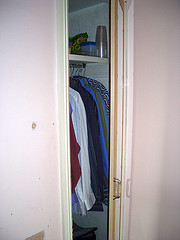 person, significant risk, but there has also been a significant change in our society around this issue.
Are we willing to “come out” as migraineurs? Are we willing to tell people we have Migraine disease? To stop complaining about lack of understanding and take a stand, educate people? Are we willing to stand up and be counted – “I’m one too!” – and change the face and the perception of this disease? I thank the GLBT movement for an extremely useful analogy.
Sometimes we need to vent about how people see our condition as “Just a Headache” or “All in Your Head.” I have done my share of ranting on this point. We don’t want to have to educate people. It’s really not fair to have all this pain and have to explain it as well! (Do you hear your Mom’s/Dad’s voice in your head, like I do, saying “but life’s not fair!”) I also know it’s hard to show up as someone with a disease. A diseased person. A disabled person. A limited person. We don’t want the world perceiving us this way. Perhaps more significantly, we don’t want to think of ourselves this way.
Diseased, disabled, limited – these are common, automatic perceptions of those with visible illnesses. Being “in the closet” is not an option with a visible illness. Here again, the amazing and courageous movement for the rights of disabled people has changed public perception. The acceptance and  accommodation of those who are differently-abled has come a long way, though there is still much further to go.
The blessing and curse of invisible illness is that it is invisible. No one can look at me and see that I have Migraine disease. If they are very perceptive, they might see that something is wrong if I’m in the midst of a migraine. No one can look at me and see that I have chronic fatigue. Sometimes they can see that I look very tired. No one can look at me and see that I have chronic sinus infections. Sometimes they can hear my hoarseness or congestion.
I think we all know what the curse of invisibility is. People do not understand our pain. They sometimes belittle it. Our employers may not accommodate us. Public events are not set up to make it easy for us to be there. Our dearly loved friends and family may think we are avoiding them, shirking responsibility, failing them. In a larger sense, invisibility means our diseases are under-funded, under-researched, medications are inadequate and specialists too few.
So what’s the blessing? When our disease is invisible, we can keep trying to show up as “normal.” We can avoid having potentially unpleasant conversations. We can avoid pity and put-downs. Of course, it’s a mixed blessing because people do see that something is wrong. I suspect some of the put-downs come from people seeing something is wrong but not knowing what it is. I think I’d rather be seen as someone with a chronic illness that interrupts my life, than as a messy flake who can’t be counted on to show up!
We need to remember that we migraineurs are 12% of the population. 12 out of every 100 people. 3 out of every 25! Whoever you are talking to, chances are they know many, many migraineurs besides you! Even more significantly, according to some estimates, 40% of Americans have some kind of chronic, invisible illness. Whoever you are talking to, they have people very close to them with invisible illness!
Lately I have been way out of the closet as a migraineur. I am in this public forum, all over the web with my real name, as a migraineur. I have gone to my business contacts and talked to them about the work I am doing as a Migraine management coach – and telling them that has involved sharing something of my personal story. I am someone with chronic illness who has built a business around my illness. I help others build workable lives around their illnesses. I can’t do that while hiding who I am.
These days when I show up at my business networking meetings, people ask me, with great concern, “how ARE you?” I told an associate recently, “feeling great today!” He breathed a little sigh of relief and asked “So your migraines are all gone?” (Hey, wouldn’t that be nice?) He wanted me to be better! It’s the kind of reaction I’ve been avoiding for years. “No,” I said, “it’s a chronic disease. It’s the way my nervous system is made. I wish they were all gone. But today I’m feeling great!” He nodded, I shrugged, and we went on to talk about something else.
A few months ago I couldn’t have had that conversation. For now, I keep showing up, assuming that people are not malicious, they are just uninformed. And I inform them. Gently, and as appropriate. They ask me what I’m doing these days and I tell them I’m focusing on helping people with  Migraine, people like me.
So hey, migraineurs, are you willing to come out and play, out here with me, out of the closet? I’d love to have your company. We can change public perception. We can create a world more responsive to our needs, more accepting of who we are.
– Megan Oltman
Don’t forget your sunglasses, it’s bright out here!
Closet image courtesy of Matthew Blank
ADA Road to Freedom image courtesy of Jay Wilson
Cave exit image courtesy of David Wilmot
Tags: Advocacy, Americans with Disabilities Act, Coming out, disability, invisible illness, Migraine disease, migraineurs
Posted in Advocacy, Communicating, Musings | Comments (7)
What are you complaining For?
March 23rd, 2008
Hi there – Happy Easter to all who celebrate it. I am up and walking around on a beautiful, chilly, early  spring day, with bulbs poking their green noses out of the dirt (and a few, their bright flowers.) I am headache free for the first time in 5 days and enjoying a lovely family visit. I really don’t feel in the least like complaining. But I thought about it a lot while I lay in bed this past week with sinus Martians and Migraine beasts fighting for control of my head. (They both won.)
Some folks just don’t like to complain. That preference is generally seen as virtuous, stoical (for which read, a good thing) and considerate. Hazel Reese’s autobiography, a tale of a life with chronic illness, is entitled I Will not Complain. I don’t intend to take anything away from the non-complainers, they have my reluctant admiration. You may have guessed that I myself do not often rank among their numbers. I do think there are several ways to look at, and use, the practice of complaining, or not complaining.
What are you complaining for? I mean what is the point of complaining? Actually there can be several points. The complaining we don’t like, the kind we, well, complain about, is the complaining that has no purpose other than to make us feel sorry for the complainer. Whining. Whinging. We don’t want to go visit Aunt Sue or we’re hardly friends with Bill anymore because all she/he does is whine. Taking it down a level, what we’re really objecting to is an evasion of responsibility. If only you knew how bad it was for me, you wouldn’t expect so much of me. If only you understood, you would take all these burdens from my shoulders.
There are several other reasons to complain, though, which are perfectly responsible, even virtuous. We can complain to get it off our chests, what we coaches sometimes call clearing. When I sit down to a coaching session with a client we usually spend a few minutes noticing if anything is getting in the way of our ability to be fully focused in the present – and if something is, we name it so we can put it aside. “I’m feeling sad about…, I’m upset by…, I’ve been angry about…” Those emotions keep on operating in the background and color the way we think and what we see as possible, if we don’t give them voice, whether we write them down or share them with someone who will help us clear our minds.
 And then there’s complaining to get results, to make change, to change history. Most of us have seen the bumper sticker “Well-behaved women rarely make history.” Any social change worth mentioning has happened with a great deal of powerful committed complaining. Public opinion does not change without an awakening of empathy. You can awaken empathy by complaining, by making sure someone else really gets it, really understands your world. I’m thinking about the ADA (Americans with Disabilities Act), which took a great deal of powerful committed complaining. For those of us with invisible illness, with Migraine Disease and the other chronic icks that have people saying “but you don’t look sick…”, it might not be a bad idea to complain more. Not like Bill and Aunt Sue, like the ADA advocates.
Try these: “I don’t look sick, but I feel like there’s a squirrel with a chain-saw in my head” (thanks Migraine Chick!); “Oh yes, I’d be fine, if only they’d stop trying to remove my brain with a grapefruit spoon” (that was me for the last week). Or a more sincere heart to heart with the non-migraineur of your choice, asking him/her to support the AHDA (Alliance for Headache Disorders Advocacy) efforts to get a fair share of NIH funding for headache disorders!
“Never doubt that a small group of thoughtful, committed people can change the world. Indeed, it is the only thing that ever has.” Margaret Mead
– Megan Oltman
Gripe, gripe, gripe!
easter egg photo courtesy of Jennifer Murawski; spring bulbs photo courtesy of irishninja01; hyacinth photo courtesy of B~
Tags: Advocacy, chronic illness, commitment to change, complaint
Posted in Communicating, Managing, Rant | Comments (4)
That disclaimer thing...
Remember: nothing we do here is medical advice or treatment or is a substitute for medical advice or treatment. Get competent medical advice to learn more about your migraines, possible treatments and risks.
What's New on Migraine Support Group Coaching |
Recent Comments
- on Calling all Redheaded Migraineurs
- on No, You’re not Crazy, You just Have Migraines
- on No, You’re not Crazy, You just Have Migraines