 RSS FEED
Archive for the ‘Advocacy’ Category
Migraine Awareness Month #1: Your First for the First
June 1st, 2012
 This is an awareness month, right? So it should be quite appropriate that the post for the beginning of the month starts with next to no awareness! It’s hard for me to tell the story of my first Migraine because I wasn’t aware enough to notice it. I have had majorly dramatic Migraines, and many of them, but my experience didn’t start out that way. It was more of a series of maybes, and a gradually building awareness.
Maybe the 1st – #1: From around age 7 to 10 I had recurrent unexplained stomach aches, great hollow, gnawing, aching pain that wasn’t nausea and wasn’t cramps and wasn’t bloating or anything to do with digestion. The pediatrician was baffled. I worried that he thought I was faking. They disappeared without having been diagnosed. It wasn’t until at least 30 years later that I read about abdominal Migraines in children. Aha?
Maybe the 1st – #2: I was 14 and an adult friend had taken me and her son to a play in Manhattan. Riding the train home afterwards I remember laying my head back on the seat with heavy pain and pressure in my forehead, and saying “I think I have a sinus headache”. Again it was decades before I learned that most so-called sinus headaches (in the absence of a sinus infection) are actually Migraines. Aha?
First awareness? – #3: At 17 I had surgery at Montefiore Hospital in the Bronx (Exploratory surgery for more undiagnosed abdominal issues. Completely unnecessary surgery, as it turned out, for my earliest IBS attacks – another story for another time). Driving home, we passed the Montefiore Headache Center. It was 1976. The Headache Center was several decades old already – the first Headache center in the world, I believe. I asked my parents what they did in a headache center, and they said they assumed there were doctors who helped people with extremely severe and frequent headaches. I remember thinking, I will probably need that someday. So even though I don’t clearly remember a Migraine that occurred before that time, at 17, I already knew.
First naming – #4: In my mid-twenties I was in law school and working harder than I ever had before, under a fair degree of stress and sleeping irregularly. I remember one April 15 in the office of the law journal I helped to edit, my friends were trying to finish their tax returns and my head was pounding, I went into the bathroom to vomit, and I remember thinking “this is a Migraine.” I don’t know where I got that knowledge; I must have read something about Migraine. I do remember that the hideous sickness was familiar to me at that time, though I hadn’t always had a name for it. I commuted to school, and a friend gave me his dorm room key and let me go sleep the Migraine off in his room. From that time on they got more frequent and the serious ones, the throwing up in the street, tear my head from my shoulders, scream and cry ones, they started then.
Glad to get this written on the first, anyway. I will have to come back and link it on the second, or I will have a Migraine soon. Not a first, not a worst, and almost certainly not a last (more’s the pity), but one I can probably avoid by getting some sleep.
Be well, my friends.
– Megan Oltman
Tags: abdominal Migraine, migraine, Migraine awareness, Montefiore Headache Center, sinus headache
Posted in Advocacy, Musings | Comments (0)
Headache on the Hill
April 21st, 2012
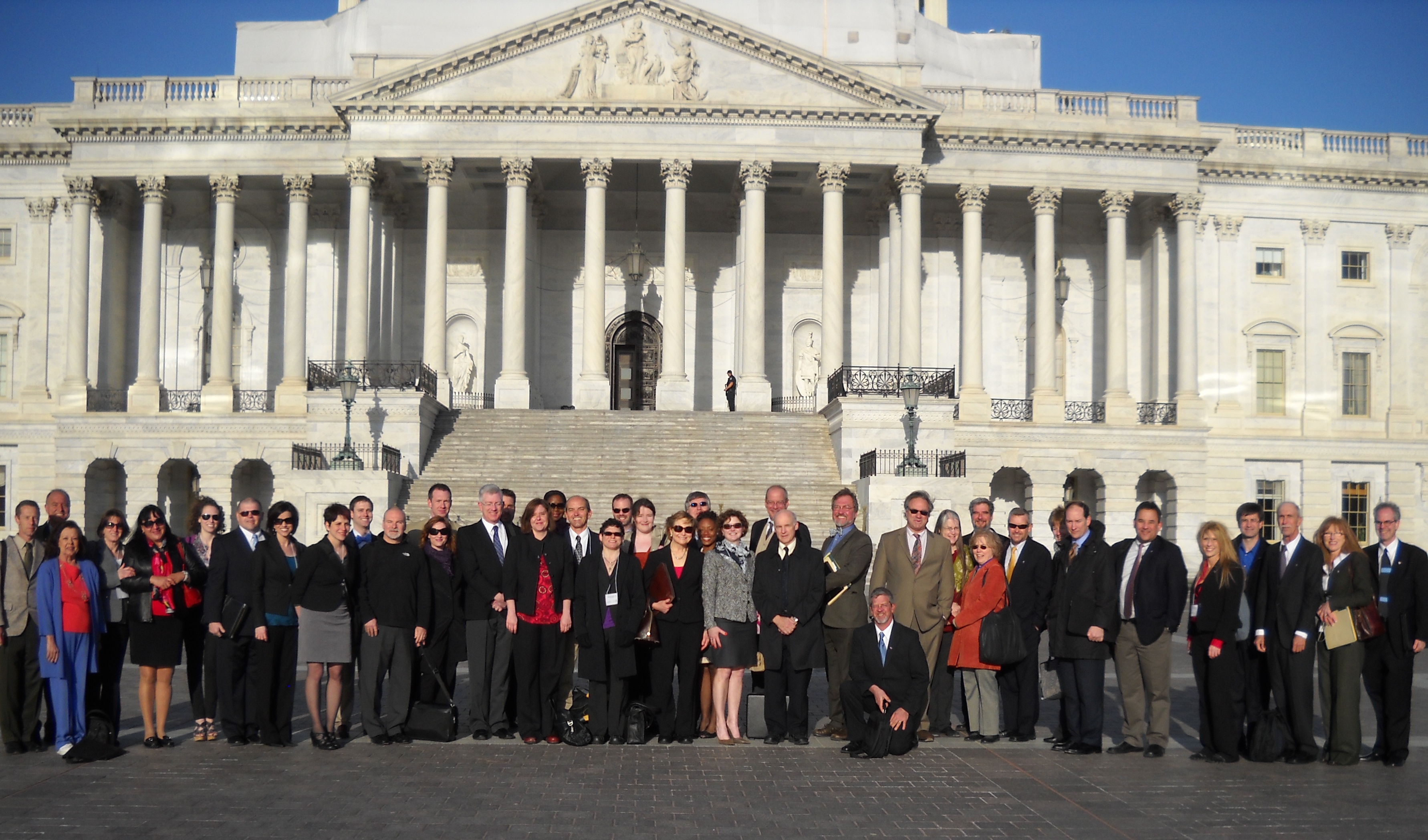
Four weeks ago I was one of sixty some-odd Migraine and Headache patients, physicians, and advocates of many kinds to spend a day and a half in Washington DC, lobbying Congress for research funding and recognition of Headache disorders.It was the Alliance for Headache Disorders Advocacy (AHDA)’s fifth annual Headache on the Hill (HOH). I participated in the second HOH three years ago and it was really inspiring to see how the group has grown in the interim. At that time I was one of very few non-physicians and very few bloggers. This year there were any number of patients, bloggers, advocates of many kinds, representatives of Migraine.com and Health Central, and NuPathe. Here we all are in front of the Capitol (I’m the short one in the orange coat):
As we tried to spread the message about how incredibly prevalent, disabling and costly these conditions are, we heard a lot of stories. Given that almost 20% of Americans experience Migraine, we discovered any number of legislators and legislative staff who either had Migraine themselves or who could tell us about how disabled their aunt, cousin, friend or coworker is by the condition. There was also a large group of Cluster Headache patients who came down to advocate for headache research. I was moved and amazed by these people who experience what is considered to be the worst kind of pain a human being can experience. Many of them were in the midst of cluster attacks at the time. We found that the legislative staff we visited had never heard of Cluster Headache. The condition is considered rare, but it is as prevalent as Multiple Sclerosis. You’ve heard of that, right?
We’re looking to have Congressional hearings into the impact of Headache Disorders. We brought our 11,000+ signature petition (if you haven’t signed yet, do it now please! Headache Impact Petition) and visited legislative aides and legislators from over 30 states. I went to the New Jersey Senators and several Congressmen with my friend, Rutgers Sociology professor Joanna Kempner, who studies the societal impact of Headache. I was moved to tears several times thinking of my sisters and brothers with chronic Migraine who could not be there – it was an honor to be able to represent you. Joanna and I told our stories, and we were able to see what incredible progress the two of us (both chronic Migraine sufferers) had made in the three years since we last walked the Hill together. (Joanna carried the torch for New Jersey by herself for the past two years when I couldn’t be there).
Here’s some of the information we conveyed to our legislators:
- Almost 1 in 5 Americans will have some form of migraine this year.75% of Americans with episodic migraine are women – mostly of child-bearing age.
- 4% of Americans have headaches more than 4 hours, at least 15 days per month.
- Among Iraq/Afghanistan war veterans, 37% of men and 57% of women reported ongoing migraine with a deployment history of concussive injury and a pre-deployment history of migraine.
- Migraine increases the risk of cardiovascular disease linked to more than 1500 US deaths annually.
- Headache disorders lead to more than $31B in economic costs in the US annually, exceeding the estimated annual US costs of epilepsy, asthma and ovarian cancer combined.
- Migraine causes more lost years of healthy life in the US annually than multiple sclerosis, epilepsy, ovarian cancer, and tuberculosis combined,… whereas NIH research funding on these 4 diseases totals more than 38 times that for migraine in 2011 ($621M vs. $16M).
- Cluster headache is reputed to be the most severe pain that humans can experience. More than half of patients have recurrent thoughts of suicide. Cluster headache is as prevalent as multiple sclerosis, yet the NIH has funded no research on it in the past 25 years.
- NIH funding for all research on headache disorders was < 0.07% of the 2011 NIH budget ($21M).
Though it wasn’t on our leave-behinds, we also talked about the increased risk of suicide to all Headache Disorder sufferers. (I think sometimes our diseases don’t get taken as seriously because they are not considered to be fatal, but between increased cardio-vascular risk and suicide risk, I think they’re fatal enough.) In general we had sympathetic listeners in the Congressional aides we met with. Congressman Rush Holt (NJ 12th district) came in while we were meeting with his aide, and both of them gave us a very warm and interested hearing.
We’re following up, and results can take a while. In the meantime, please contact your legislators and let them know how you are impacted by Headache Disorders. We can make a difference.
– Megan Oltman

Tags: AHDA, Alliance for Headache Disorders Advocacy, Congress, Headache on the Hill, Joanna Kempner PhD, Rush Holt
Posted in Advocacy | Comments (2)
Spammedy, spam, spammedy spam…
April 1st, 2012
Hello friends – I’ve been gone a long time and I’m so glad that (real) people still come by and visit Free My Brain. The needs of working and earning a living have gotten in the way of my blogging for a long time. There’s good news in that, in that I have been well enough to work full time, but bad news too as we continue to struggle economically and the stress level of my life remains high. Not to mention that I miss the wonderful relationships and the fun back and forth of the on line world. Ever since getting back from Headache on the Hill this week, and remembering who I am as part of this Migraine advocacy community, I have been determined to get back to Migraine blogging and coaching, even if just a little at a time.
With help from my resident tech-guru husband and at the recommendation of dear blogger friend Diana Lee, I am installing Disqus for comments, in the hope that real people will once again be able to talk to me, rather than spam-bots. (I hope Danny can get to it this weekend. He just started a new contract position Thursday so has been working on that, which has to take priority since it pays the mortgage.) Some of you have tried to leave comments and somehow haven’t been able to; I’ve had quite a few emails from my “contact me” page alerting me to something wrong with the comment function. Spam-bots don’t seem to have any trouble with it, though. I’ve gotten thousands of spam comments over the past year and a half or so. They were piling up in my comment moderation box, and several hundred even managed to spill over to the “approved” side though I sure as hell never approved them! I don’t know how that works, but I spent hours deleting them all over the last few days.
And so, just so those hours of purging will not be completely wasted, I wish to share with you some of the choicest cuts of spamminess – worthy of a Monty Python breakfast (spam sausage spam spam bacon spam tomato and spam).
The thing about the spam comments is they just manage to sound almost human, but not quite. At first I thought they were all written by non-English speakers, but if you are human and speak any language at all you have some grasp of syntax, which is notably missing here.
First, the marvelous compliments:
“Treasured… I totally wonderful this item!” (And I totally wonderful your use of English!)
“Excellent site. It was pleasant to me.” (So nice of it; too bad you weren’t pleasant enough to leave it alone.)
“Splendid… I seriously great this post!…” (Wow, and you seriously grate on my nerves!)
“Eloquent… Smooth rhetoric in this item. I wondered if I was reading Richard Nixon.” (Well, hey now, is that any way to speak to someone who lived through Nixon’s rise and fall? Not that he wasn’t eloquent in his lies, but I’ve surely never modeled myself after him!)
“Simply wish to say your article is as astonishing. The clearness in your post is simply nice and i could assume you are an expert on this subject.” (Sounds almost human, though to be astonished by something simply nice would require some kind of weird mental gymnastics. Maybe this was a real human after all and I should take in that I am simple yet astonishingly nice. Except not right now.)
“Great beat! I wish to apprentice while you amend your website. The account helped me a acceptable deal. I had been tiny bit acquainted of this your broadcast provided bright clear concept” (Yeah… I got rhythm…)
And just for the sheer nonsense of it, “Log Cabins Loch Lomond” contributed “Thanks erst much for distribution this on line. I sure every bit of it.” (Well, by yon bonnie banks and by yon bonnie braes! You’re welcome erst much! I sure… every um… what you said.)
But rest assured, I am not universally loved by spam-bots, some criticize me thusly:
“I can impartially state that I didn’t get it… Check out this gibberish… Do others think they believe it?” (And I can impartially state that you are pretty darn good at gibberish yourself.)
“Grow taller for idiots review. Another post of fail… Why do you even bother ?” (Indeed. Why do I even bother, when I grow taller neither for idiots nor for geniuses? Five foot two and a half ever since I was fifteen. Ah me!)
And just in case you were wondering “how to quit smoking pot. {Simply|Just} {want to|wish to|desire to} say your article is as {astonishing|amazing|surprising|astounding}. The {clearness|clarity} in your post is {simply|just} {spectacular|nice|excellent|cool|great} and i {can|could} assume {you are|you’re} an … (Multiple choice spam? I’ll have the spam spam spam sausage and spam!)
But perhaps the creme de la creme:
“Fleece Blanket. Funny Thing Happened… While I was flipping through the post, a cat just swallowed my pet ferret!” (In fact, fleece blanket, that would be sad, if you were a human with a pet ferret. Luckily, it is highly unlikely.)
That’s all for now. Wishing you a spam and Migraine free tomorrow.
– Megan
Can of Spam image courtesy of AJC1.
Tags: Advocacy, blogging, Headache on the Hill, migraine, spam
Posted in Advocacy, Communicating, Rant, Silliness, Weblogs | Comments (1)
Migraine Meet up in Real Life
June 14th, 2011
 Some of my dear bestest buddies from the forum over at My Migraine Connection were over at my house on Sunday, for reals! It was so wonderful having MaxJerz (and her Mom) and KatintheCorner in my own space. MJ was back visiting my state, where she grew up, after being gone for five years; she came up with the idea. Kat came down from her corner of the state and I picked her up from the train. We were sorry the timing was such that EG couldn’t join us from yet another direction. I also wish we’d thought to take a picture. My old standby heads-together statue will have to serve. I love this photo, though, it makes me think of Migraine sufferers helping each other – putting our heads together.
I always feel super responsible when I host something, and of course I was feeling responsible for our weather – it had been super hot, then thunderstormy, and I worried about everyone’s heads. Why do I think I’m responsible for the weather? The day itself was humid but not too hot, and overcast. All our heads held up well enough. Beforehand of course I cleaned myself half dead (and give credit where due – my Danny man did the same), but was worrying about all the things we hadn’t gotten to.
Everyone was so easy and natural it wasn’t too hard to give up my obsession to make things perfect and just enjoy being in their presence. It’s an amazing thing to meet people you know intimately, but have never been with before. It’s fun to just experience the way people move, their gestures, their voices, when your contact so far has been in words and pictures. And to give real hugs where you’ve sent lots of virtual ones before. People are great in three dimensions! It’s fun to be three dimensional too- to tell my funny stories and ham it up the way I like to. Can you all tell from this blog that I’m pretty goofy? (Yes, intelligent, well-informed, authoritative, but goofy.)
It was a quick visit, but a great one. I’ve gotten to meet lots of great Migraine buddies lately – been meaning to blog about the Migraine focus group I was in for the past month – I promise I’ll get to it soon. It’s a funny thing; it’s not that Migraine sufferers are all that unusual – we’re about 12% of the population. Even those who are or have been chronic Migraine sufferers aren’t that unusual, though we’re a minority of the Migraineur population. But those who are active on-line, are advocates, are seeking help and to help one another, we’re not your common or garden-variety. It’s an honor to be part of this community, and a pleasure to have you all in my own living room.
– Megan
Tags: Migraine activists, Migraine sufferers, migraineurs, on-line activisim, patient advocates
Posted in Advocacy, Weblogs | Comments (1)
Botox News: Can I do Migraine Education without Getting Nasty?
October 21st, 2010
 Have you heard the news? Botox has been approved by the FDA for treatment of chronic Migraine. I first heard it from Diana Lee at Somebody Heal Me, but it’s been in the press this past week. This is great news for many chronic Migraineurs. Health insurers who have been refusing to pay for the highly expensive treatment will now lose the excuse that it is not a standard, accepted treatment. The FDA approval probably doesn’t guarantee they will cover it, but makes it much more likely. Like most Migraine treatments, Botox doesn’t work for everyone. As I understand it, for some Migraineurs, the injections into specific points in their heads and necks paralyze muscles that otherwise would contribute to the triggering of Migraines. With FDA approval, the treatments will be available for a much larger group of sufferers.
I guess some jokes are inevitable. Just for the record, the injections are highly unlikely to be into the same spots in your face that would plump up wrinkles, unless you just happen to have a wrinkle on one of those trigger points. Sorry. But I just ran across someone joking about it, and it got my goat.
A friend of mine who is a M.D. and has a great understanding about Migraine, has been very supportive of me, and also happens to work in a company that manufacturers dermatological products (so you could see she has some professional interest in the topic) posted a link on Facebook to the FDA approval of Botox. I commented that it was great news. Another friend of hers (who I don’t know) commented after me, saying “suddenly, I feel a headache coming on. sign me up!” Okay, I don’t know if this woman is a Migraineur or not and I don’t want to go off half-cocked, but it put me on slow burn. First I kind of shrugged, then read it again and was annoyed and gradually I’m getting that agitated feeling in my stomach… that could lead to a Migraine, among other things.
I’m trying to get at my feelings. The implication that I read there is that it’s a joke that you could get Botox for a “headache,” that people should fake headaches in order to get cosmetic Botox treatments. It trivializes our condition, maybe completely unknowingly, but even so. I was inclined to let it go so as to not drum up trouble, but if I don’t take on an opportunity to educate, I’m not being true to myself. So I’m going to answer her. If you’re reading this post on Facebook, I already have.
Of course I’d love to really let loose, but I want to educate, not alienate, so here’s what I’m saying:
Migraine disease is a serious neurological illness which is one of the top 20 most disabling conditions world-wide. Chronic Migraine sufferers have Migraines 15 or more days per month. For some of us, Botox helps prevent or lessen the impact of some of the Migraine attacks. The Botox is not injected in places that would help anyone with their wrinkles. It may be surprising, or sound strange, but it’s not a joking matter. I don’t think you intended to offend, but please understand that your comment trivializes a very real disease suffered by 36 million people in the USA alone.
What do you think? Am I doing right by our cause?
– Megan
Tags: Botox, Botox for Migraine, chronic migraine, migraine advocacy, Migraine disease, Migraine education
Posted in Advocacy, Communicating, Current Affairs, Medicine, Rant | Comments (1)
Speaking to Pharma Marketers
October 16th, 2010
 On Thursday of this week I had a great opportunity. I was invited by Jack Barrette of WEGO Health to be on a panel presenting Health Activists’ perspectives to pharmaceutical marketers. The conference was called the Multi-Channel Pharma Marketing Event, and participants were hearing about how to market in a new world of informed medical consumers, health activists, and social media. My fellow panelist was Allison Blass, of Lemonade Life, a diabetes blogger and activist.
So here’s what I think about Migraine and pharmaceutical companies, what I went into this conference with. First of all, pharma companies want to sell their drugs, because that’s what they do, and how they make their profits. So marketers are looking for new and better ways to… that’s right, market their products. Do their companies make too much profit? Are drugs too expensive? Well it is very expensive to develop new products, and takes years and years. I understand this. The fact that insurance companies are run on a profit motive is a harder one for me to take – their motive will never make them want to give us all we need to treat our disease, and the fact that we have uninsured people, and no universal, single-payer system, so some people can’t afford meds at all, and others are at the mercy of insurance companies that ration meds, those are the real crimes. Don’t even get me started!
So how much should pharma companies profit? I don’t know. I don’t know whether they make more profit than say, banks and financial companies. I do know they  make something we need, and our system runs on profit. And here’s where the Migraine angle comes in – they don’t make enough of what we need, the basic research hasn’t been done yet, they haven’t developed the drugs, we haven’t had a real new innovation since the triptans, and we need better products to prevent and treat Migraines. Desperately! You with me so far? What we really need is a cure, as Allison said, so ultimately the pharma companies should be in the business of putting themselves out of business. Because it’s the right thing to do.
In the meantime pharma companies want to get involved in social media, because that’s where not only consumers but opinion leaders are. I asked a number of you on Facebook to tell me what I should say to them, and there was a fair degree of skepticism about their motives. It seemed to me the people I met were decent, committed people, who are selling things they believe in. As one told me, he’d rather be selling drugs that help people then a lot of other things.
Anyway, Jack asked us to speak on what the rules of the road are, and what we would do if we had 10  million dollars to spend in our health communities. Allison and I expressed things in different ways but came up with a number of very similar ideas. I said, Rules of the Road: you have the power to educate, use it wisely and well. Don’t try to sell something like Excedrin Migraine as if it were a one-size fits all solution, a cure, and fail to disclose that 1. it doesn’t abort your Migraine, only covers up the pain; 2. it won’t kill the pain for many of us; and 3. it carries a substantial risk of Medication Overuse (rebound) Headache if used more than a couple of days in a row, or a couple of days a week. It was easy to pick on Excedrin Migraine because so many of us Migraineurs love to hate their ads!
As for the Imaginary 10 million, how about spending most of it to get the basic research about this disease done? Support Alliance for Headache Disorders Advocacy and Migraine Research Foundation. Then if they want to spend some money on line supporting our community, sponsor patient education, Migraine diaries, information about a whole life approach to managing Migraine (an approach that pharmaceuticals are only one part of). Let some more of us who are committed to helping people with this disease become professionals at it by supporting our efforts with paid positions. Life costs money (as Allison said) and people with the passion to help should be able to make a living at it. And if you support and sponsor what our community needs, and are known as good guys, we will be more eager for your products when they are finally developed, and more likely to continue using your products over time, if they do their job.
The audience was great, asked terrific questions, and it was a great experience. Kudos to Jack who had me really get present again to what I am doing and why. As you may know if you read my sparse postings lately, I have been working a demanding day job as an attorney and mediator, and haven’t found much time to be on line lately. Well, I’m lit up and raring to go, so expect to hear some more from me.
– Megan
Tags: Alliance for Headache Disorders Advocacy, migraine, Migraine research, Migraine Research Foundation, Multi-Channel Pharma Marketing Event, pharmaceuticals, WEGO Health
Posted in Advocacy, Medicine | Comments (0)
Blue Tuesdays
April 20th, 2010
On Tuesdays there are staff meetings at my new office, at 8:30 a.m. That may not be ridiculously early, but  it means I have to be up at 7 and racing through my morning to get there on time. The nortriptyline I take as a Migraine preventive makes me good and sleepy, and it’s hard to wake up and move on less than 9 hours of sleep. Today I not only had to be awake but to give a little presentation at the meeting on using Facebook and Twitter for business. I am relearning some things I used to know, like how to get up and go even when I don’t feel up to it. How to push myself through times when my focus isn’t there, or I’m a bit fatigued, or to work with a triptan in my system.
Don’t get me wrong, this new job wouldn’t even be happening if my Migraine prevention regimen weren’t working quite well. My Migraines went down by about 60% in the months before I started the job. The challenges of the work routine have them back up a little again, but it’s still significant progress. If I had tried to take on the challenges of this job a year ago, I doubt I could have done it.
I also work an 8 1/2 hour day on Tuesdays and Thursdays because Monday and Friday are my short days and Wednesdays are a day off. That’s just the way we worked out for me to work a 25 hour week. It makes those long days challenging, though. If I don’t sleep well the night before (like last night) and I still go put in a full day, it can lead to an evening Migraine. Right now I am lying down with the laptop, writing to you all after dinner, with a bit of a headache. Trying to see if I can contain it by resting. That works sometimes.
One of the difficulties for me is that I can’t seem to go to sleep and get up at the same time every day the way my Migraine brain demands. I need plenty of sleep, and if I went to bed early enough to make the Tuesday wake-up hour my standard, I’d never get to see my teenage kids or night-owl husband. I’d be best off if I could take a nap to even things out, I think, but short of napping in my car that’s not an option right now.
All in all, I am very grateful to have a job, to be doing professional work and helping people, to be getting some respect and recognition, and earning a living. I am grateful that I still have Wednesdays to keep working at my Migraine coaching. I had forgotten, as a self-employed person for many years, how satisfying it is to leave at the end of a work-day, knowing I had filled the day with doing my best, and that I am done for the day. I am enjoying my evenings more, and allowing myself to relax. Except that these Tuesdays are hitting me hard!
– Megan
Sleepy law student image courtesy of umjanedoan.
Tags: Migraine coaching, Migraine preventive medication, part-time work, sleep hygiene, triptans
Posted in Advocacy, Managing, Musings, Weblogs | Comments (0)
Support the Future of Headache Medicine in the U.S.
December 9th, 2009

 The AHDA (Alliance for Headache Disorders Advocacy) makes us aware of an opportunity to make a difference in the future of headache medicine. Please take action today to support the the Klobuchar / Collins Amendment to the Senate Health Care Reform Bill. Apparently the bill sets up bonus Medicare payments to doctors from certain primary care specialties. This will give an incentive and encourage doctors to enter and stay in primary care practice.
The AHDA tells us:
Physicians who specialize in headache medicine provide primary or principal care for patients with headache disorders and more than 90% of them are neurologists. Unfortunately, neurologists have been unaccountably left out of eligibility for these bonuses. If the Health Reform Bill passes with the incentive program as it is written, it will significantly undermine the ability to recruit and retain doctors to the field of headache medicine. Headache doctors are already very scarce, and it will become that much harder to find one.
Senators Klobuchar of Minnesota, Collins of Maine and Brown of Ohio, created a bipartisan amendment to the bill that would add neurologists to the Medicare incentive program. The AHDA is backing the amendment along with other groups that support sufferers from neurological diseases, including the American Academy of Neurology, the ALS Association, the Parkinson’s Action Network, the Epilepsy Foundation, the Brain Injury Association of America, the Alzheimer’s Foundation of America, and the National Multiple Sclerosis Society.
In five minutes or less, you can add your voice to support for the Klobuchar / Collins Amendment and help encourage doctors to go into and stay in headache medicine. Just go to the AHDA’s special dedicated page: Email Your Senators to Support the Klobuchar/Collins Amendment. They’ve designed it to be really easy – please just take a few minutes and do it now! That is all.
– Megan
Tags: Alliance for Headache Disorders Advocacy, headache disorders, headache specialists, health care reform
Posted in Advocacy, Current Affairs, Medicine | Comments (0)
Express Migraine to Congress
October 24th, 2009
Betsy Blondin, editor and creator of the spectacular book of art and writing by Migraineurs, Migraine  Expressions, has created a new advocacy campaign. A friend suggested that people purchase a copy of Migraine Expressions for their U.S. Senator or Representative, to help raise awareness and understanding of our disease in Congress. Betsy loved the idea and launched the effort to “Express Migraine to Congress.” At least 7 books are on the way to Congress!
To participate, purchase a book for $18.95 here: Express Migraine to Congress, and let Betsy know on the PayPal form or via e-mail which Congress person to send it to. Betsy will keep track of the Congress members receiving books so we won’t duplicate efforts on Betsy’s blog here. For each book purchased for Congress, Betsy will donate $1 to the Alliance for Headache Disorders Advocacy (AHDA) toward advocacy efforts.
If you can’t afford to buy a book, you can use the links on Betsy’s Senate and House of Representatives pages to send a message to your Congress members, asking them to help millions of Migraineurs by supporting Congressional hearings and increased funding for migraine research.
I’ll be going to the AHDA’s third Headache on the Hill day of advocacy in February, and these books sent to Congress beforehand will help raise awareness of what we are lobbying about. Momentum is building for Congressional action. Our lobbying efforts have resulted in legislative report language supporting increased attention by the NIH for migraine research. Cindy McCain coming forward as a Migraineur and pledging to advocate for Congressional hearings, has to increase our visibility.
Let’s support Betsy in this great idea to raise awareness!
– Megan Oltman
Tags: AHDA, Congress, Headache on the Hill, migraine advocacy
Posted in Advocacy, Books | Comments (0)
Socialize my Medicine, Please!
September 23rd, 2009
 I went to a business lunch & learn presentation today, given by a very nice insurance agent, all about health insurance. He covered the history of health insurance, how we got in the mess we’re in today, and some ideas about how to fix it. His intention was to give business owners an idea of some options and choices that exist now. Well, we didn’t really get far into that last part, as so much of the time was taken up with people’s impassioned views on the subject of our health care system. Not surprising in the USA today.
A lot of views were expressed about how people overuse medical care, and doctors over-test and over-prescribe in order to cover their butts against potential liability, how we expect higher standards of care than in the past, how we take too many prescription drugs and don’t emphasize prevention enough. I can get with most of that, as far as it goes. I think health education and healthy lifestyle choices could be much more emphasized. I think the practice of defensive medicine is a real problem. But I don’t think the answer is to turn back the clock and say if you injure your knee you should just live with the limitations for the rest of your life, rather than having rehabilitation available. I don’t think having real effective treatments for conditions that were taken for granted throughout human history is a bad thing. People don’t have to suffer like they did – throughout human history.
It was more than I could do in the short time we were together to really make the case for chronic illness, though I tried. We all need to be responsible for ourselves, and take care of ourselves, and looking to a doctor or a pill to solve everything is not the answer. But many of us do not have the option to go without medical care – we cannot function without it. And the advances in medicine that may be seen as excessive or unnecessary by some are not happening fast enough for us, to help us function.
Many of us with chronic illnesses are living the healthiest lifestyles imaginable. We’ve cut out the unhealthy things that others just think they should cut out. We don’t have a choice because these things make us sick now. One guy said he thought it was crazy that healthy people and sick people should pay the same insurance premiums. This shows the problem with a traditional, for profit insurance risk model – but how can any rational person say that you have to be extremely wealthy to be a sick person? Should I pay twice (or five times) as much for my insurance as you? In other words if I get sick, if I have a genetic predisposition to disease, have an accident, or am just unlucky, I should go broke and end up an the street in order to pay for my care? Or maybe I should just die? A pure for-profit insurance model like this guy was championing, that’s the real death panel. (Choosing who should live or die based on ability to pay. We have that in this country right now!)
I’m responding to things that I couldn’t respond to at the time without completely diverting the conversation. Unlike some wingnuts in town hall meetings around this country, I’m polite enough not to shout people down. Most of the time.
But what really got me was when we started talking about the Canadian model – interestingly, our presenter was a Canadian, living in the US for the last 15 years. He debunked the myth that people wait years for needed surgery in Canada. The same guy whose views I took issue with above said that in Canada the health care is free but the beer is really expensive. He said, “I’d rather have a cheap six-pack than a heart transplant.” Now listen, he was trying to be funny, but come on. Ask anyone on the street if they’d rather have a beer or a heart transplant, and chances are only those who need heart transplants are going to opt for the second choice. Even if you don’t like beer… The point is, that if you need a heart transplant, you should be able to have one without worrying about losing your life savings, or dying without the care you need. And yeah, go on and tax the unhealthy things to pay for the healthcare. Makes sense to me!
– Megan
Hit in the head image courtesy of Pawel Loj.
Tags: chronic illness, health care reform, health insurance
Posted in Advocacy, Current Affairs, Rant | Comments (4)
That disclaimer thing...
Remember: nothing we do here is medical advice or treatment or is a substitute for medical advice or treatment. Get competent medical advice to learn more about your migraines, possible treatments and risks.
What's New on Migraine Support Group Coaching |
Recent Comments
- on Calling all Redheaded Migraineurs
- on No, You’re not Crazy, You just Have Migraines
- on No, You’re not Crazy, You just Have Migraines